ISO 9001 - Quality Management System and ISO Certification
In today’s competitive global market, organizations are expected not only to deliver high-quality products and services, but also to demonstrate consistency, reliability, and continuous improvement. This is why ISO 9001 remains the world’s most recognized standard for quality management systems (QMS).
What is ISO 9001?
ISO 9001 is an international standard for quality management systems developed by the International Organization for Standardization (ISO). The standard defines requirements for establishing, implementing, maintaining, and continually improving a quality management system within an organization.
ISO 9001 focuses on:
- customer satisfaction,
- process effectiveness,
- risk-based thinking,
- leadership involvement,
- continual improvement,
- operational consistency.
The standard can be implemented by organizations of any size and from any industry.
Today, ISO 9001 certification is used by more than one million organizations worldwide, making it one of the most widely adopted ISO standards globally.
ISO 9001 Certification
One of the key aspects of ISO 9001 is the possibility of obtaining accredited ISO 9001 certification through an independent certification body.
ISO 9001 certification confirms that an organization has implemented a quality management system aligned with internationally recognized requirements.
The certification process usually includes:
- implementation of the quality management system,
- internal audits and management review,
- certification audit conducted by a certification body,
- issuance of the ISO 9001 certificate,
- surveillance audits and recertification.
Many organizations pursue ISO 9001 certification to:
- improve credibility,
- meet customer requirements,
- participate in tenders,
- strengthen market position,
- standardize operations,
- improve quality performance.
Benefits of ISO 9001 Implementation
Improved Process Efficiency
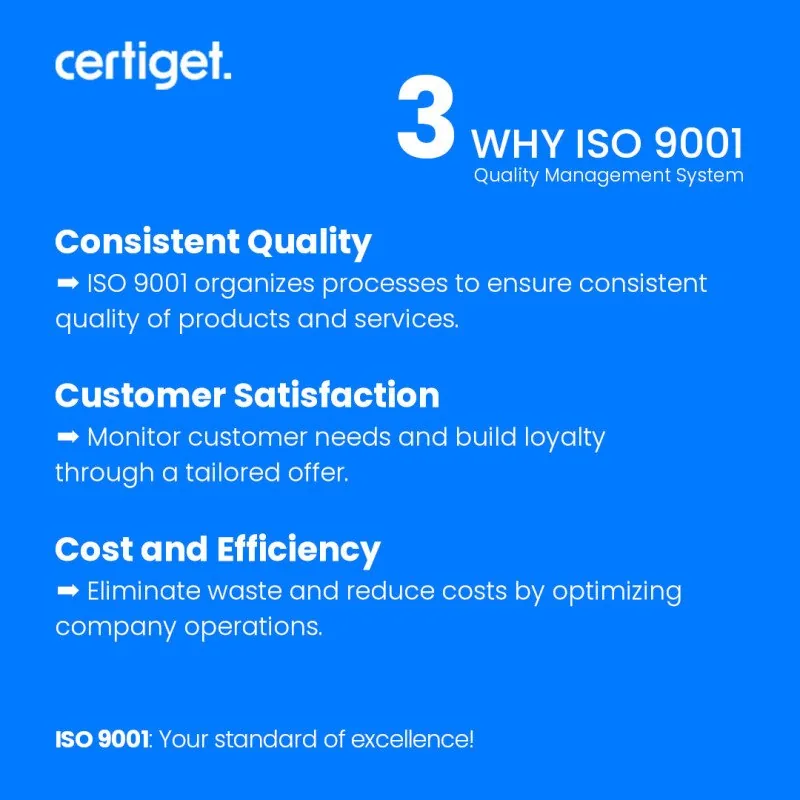
ISO 9001 promotes a process-based approach to management, helping organizations identify inefficiencies, reduce waste, and improve operational performance.
Optimized processes often result in:
- lower operational costs,
- improved consistency,
- better resource management,
- reduced errors and rework.
Increased Customer Satisfaction
Customer focus is one of the core principles of ISO 9001.
Organizations implementing ISO 9001 are encouraged to:
- understand customer expectations,
- monitor customer satisfaction,
- manage complaints effectively,
- improve products and services continuously.
A well-functioning quality management system helps build trust and long-term customer relationships.
Better Risk Management
The ISO 9001 standard incorporates risk-based thinking, enabling organizations to proactively identify risks and opportunities affecting quality and business performance.
This supports:
- better decision-making,
- operational stability,
- prevention of nonconformities,
- improved business resilience.
Stronger Organizational Structure
ISO 9001 helps organizations clearly define:
- responsibilities,
- authorities,
- processes,
- objectives,
- performance indicators.
This improves communication, accountability, and management effectiveness across the organization.
Quality Management Principles in ISO 9001
ISO 9001 is based on seven quality management principles:
- Customer focus
- Leadership
- Engagement of people
- Process approach
- Improvement
- Evidence-based decision making
- Relationship management
These principles form the foundation of an effective and sustainable quality management system.
ISO 9001 for Small and Large Organizations
One of the major strengths of ISO 9001 is its flexibility.
The standard can be implemented by:
- small businesses,
- manufacturing companies,
- service providers,
- IT organizations,
- public institutions,
- global corporations.
ISO 9001 can be adapted to the size, complexity, and operational context of the organization.
Standards and Guidelines Supporting ISO 9001
Many organizations implementing ISO 9001 focus mainly on certification requirements. However, the ISO quality management family also includes several supporting standards and guidelines that help organizations improve process maturity, organizational culture, and management effectiveness.
Some of the most important supporting standards include:
- ISO 9004 - guidance for achieving sustained organizational success and improving management system maturity,
- ISO 10018 - guidance on people engagement, quality culture, and organizational awareness,
- ISO 19011 - guidelines for auditing management systems,
- ISO 10002 - customer satisfaction and complaints handling management,
- ISO 10003 - dispute resolution guidelines related to customer complaints,
- ISO 10015 - competence management and training guidance,
- ISO 10013 - guidance for documented information and quality management system documentation.
These standards help organizations gain more value from ISO 9001 implementation beyond certification itself.
Choosing an ISO 9001 Certification Body
Selecting the right certification body is an important part of the ISO 9001 certification process.
Organizations should consider factors such as:
- accreditation,
- industry experience,
- international recognition,
- audit approach,
- pricing,
- reputation and customer reviews.
On certiget.pl and certiget.eu you can find a detailed directory of management system certification bodies from around the world, with the ability to:
- compare certification offers,
- search by ISO standard,
- verify accreditation,
- review certification scopes,
- analyze certification body profiles.
Certiget operates as an independent ISO certification marketplace and comparison platform supporting organizations in selecting the right certification partner.
Why ISO 9001 Matters
ISO 9001 is more than a quality management standard. For many organizations, it becomes a framework for operational control, business improvement, and long-term development.
An effective ISO 9001 quality management system helps organizations:
- improve efficiency,
- increase customer satisfaction,
- strengthen market credibility,
- manage risks,
- support continual improvement,
- create a culture of quality.
Implementing ISO 9001 and obtaining certification is often not only a compliance decision, but also a strategic investment in organizational growth and competitiveness.